
記事一覧へ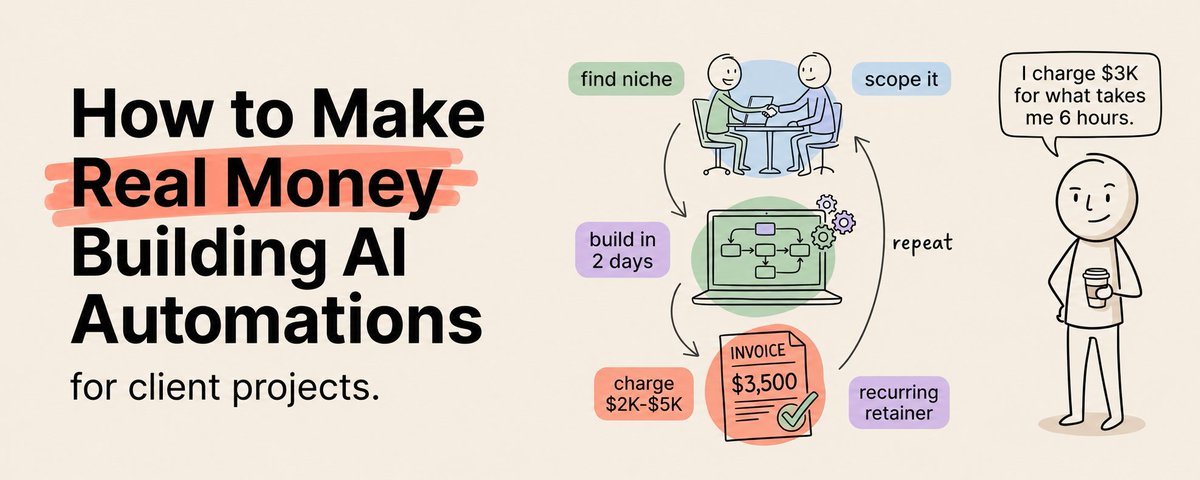
今、ほとんどの人が気づいていないゴールドラッシュが起きている。
保存しておこう :)
中小企業は手作業に溺れている。AIが存在することは知っている。ニュースで聞いたことがある。ChatGPTを一度か二度試してみたことがある。
でも、実際にそれを使って自分たちの問題を解決する方法は、まったくわからない。
「AIが存在する」と「AIが自分の問題を解決している」の間のギャップ、そこに今お金がある。
ソフトウェアエンジニアである必要はない。Claudeを理解して、基本的な自動化を構築でき、その価値を平易な英語で説明できれば十分だ。
今これをやっている人たちは、自動化1件あたり〜,000を請求している。月,000〜,000の継続収益を積み上げている人もいる。市場はあまりに未開拓で、ほとんどの人が最初の3クライアントを飛び込み営業や口コミで見つけた。
始め方を正確に説明しよう。
なぜ中小企業はAI自動化にお金を払うのか
中小企業は大企業と同じ運営上の問題を持っているが、解決するためのリソースが全くない。
5名の弁護士事務所は、週10時間を顧客文書の手動整理・要約に費やしている。不動産会社は週8時間を物件説明と市場分析の作成に費やしている。マーケティング会社は週15時間をクライアントコンテンツの初稿作成に費やしている。会計事務所は週12時間を経費報告の処理・分類に費やしている。
これらは複雑な問題ではない。明確なパターンに沿った、繰り返し発生する時間がかかる問題だ。
Claudeはそのすべてを解決できる。
でも事業主はそれを知らない。Claudeが何か知らない。システムプロンプトが何か知らない。CoworkやRoutinesが何か知らない。週10時間を、10時間もかかるべきではないことに費やしていると感じているだけだ。
そのギャップを埋めるのがあなただ。
ステップ1:ニッチを選ぶ
「中小企業」を対象にしようとするな。広すぎる。それを理解していない、気にもしていない人たちにAIを説明しようとして数ヶ月を無駄にする。
1つの業界を選ぶ。そこの具体的な問題を学ぶ。その具体的な問題のための解決策を作る。
今、AI自動化に最適なニッチ:
不動産会社——物件説明文、市場分析、クライアントフォローアップメール、物件比較、CMAレポート。エージェントは文章を嫌い、しかも大量に書く。
法律事務所——文書要約、契約書レビュー、クライアント受付処理、法的調査まとめ。弁護士は時間以上で請求し、管理業務を嫌う。
マーケティング会社——コンテンツ初稿、ソーシャルメディアカレンダー、競合調査、クライアントレポート。会社はいつもクライアント負荷に対してスタッフが足りない。
ECビジネス——商品説明文、カスタマーサポートテンプレート、在庫分析、レビューモニタリングと返信下書き。
会計事務所——経費分類、領収書処理、レポート生成、クライアントコミュニケーション下書き。
採用会社——履歴書スクリーニング、求人票作成、候補者へのアウトリーチ下書き、面接サマリーレポート。
最も既存の知識やコネクションがあるニッチを選ぶ。信頼性が生まれ、会話が楽になる。
ステップ2:彼らのワークフローを学ぶ
何かを作る前に、ターゲットクライアントがどのように働いているかを正確に理解する必要がある。
選んだニッチで3〜5人と話す。こう聞こう:
「典型的な1週間を教えてください。何に最も時間がかかっていますか?」「誰かに任せられたらと思うタスクはどれですか?」「繰り返しやっていて、もっと速くできるはずだと感じることは何ですか?」「スキルより低いレベルのタスクで時間を無駄にしていると感じるのはどこですか?」
注意深く聞く。全部書き留める。こんな条件のタスクを探している:
繰り返し——毎日か毎週やる
パターンベース——タスクが毎回似た構造に従う
時間がかかる——1回あたり30分以上
低複雑度——深い専門知識や創造的判断を必要としない
この4つすべてに当てはまるタスクはすべて、潜在的な自動化だ。
ステップ3:コンセプト実証を作る
特定した最もインパクトの大きいタスクを1つ取り上げ、Claudeを使った動作する自動化を作る。
完全な製品を作る必要はない。事業主に見せるデモンストレーションが必要だ: 「あなたが2時間かけているこのタスク、Claudeがやると5分でこうなります。」
不動産会社なら、こんな感じかもしれない:
生のMLS物件データシートを取る。これをClaudeに渡し、システムプロンプトで言う: 「あなたは高級不動産のコピーライターです。このデータをもとに、魅力的で感情に訴える物件説明文を書いてください。最もユニークな特徴を最初に強調してください。感覚的な言葉を使ってください。300語以内にしてください。行動を促す文で締めてください。」
エージェントに生データが入力され、磨かれた物件説明文が出てくるところを見せる。
この5分間のデモは、書けるどんなセールストークよりも価値がある。エージェントは自分の実際の問題が目の前で解決されるのを見る。売り込みはほぼ自分でできあがる。
ステップ4:オファーをパッケージ化する
「AIコンサルティング」を売るな。誰もその意味を知らないし、高くて複雑に聞こえる。
具体的な成果物を伴う具体的な成果を売ろう。
パッケージ1: クイックウィン(〜,000)
1つの特定タスクに対する1つの自動化。あなたが作って、テストして、使い方を文書化して、動作するClaude ワークフローとして——システムプロンプト、コンテキストドキュメント、ステップバイステップの手順付きで——納品する。
成果物: クライアントが自分で動かせるドキュメント化されたClaudeワークフロー。
期間: 1〜2日。
パッケージ2: システム構築(,000〜,000)
ワークフロー全体をカバーする3〜5つの自動化。Coworkの設定やClaude Codeのルーティンを作って、受付から出力まで全プロセスを処理する。
成果物: 複数のワークフロー、コンテキストドキュメント、接続ツール、クライアントチームへのトレーニングを含む完全なシステム。
期間: 1〜2週間。
パッケージ3: マネージドサービス(月,000〜,000)
継続的に彼らのAI自動化システムを構築・管理する。アップデート、改良、新しい自動化、トラブルシューティングを担う。クライアントは月払い。
ここに継続収益がある。
成果物: 節約時間と生産量の月次レポート付き完全管理AI運用。
最初はパッケージ1で最初のクライアントを獲得する。事例ができたらパッケージ2へ移行。継続的な関係ができたらパッケージ3を追加する。
ステップ5: 最初の3クライアントを見つける
ウェブサイトは不要。ファネルも不要。オーディエンスも不要。
3つの会話が必要だ。
方法1: 直接アウトリーチ。
選んだニッチのビジネスをGoogleマップ、LinkedIn、地域ビジネスディレクトリで探す。短くて具体的なメッセージを送る:
「[名前]さん、[ニッチ]の会社が[特定タスク]をAIで自動化して週10時間以上節約できるよう支援しています。最近[事例か想定例]で[特定タスク]の時間を週8時間から45分に短縮しました。15分のコールで動く様子をお見せできますか?」
方法2: 既存のネットワーク。
すでに知っている中小企業を経営している人は誰か? 親、友人、元同僚が知っている人は? 紹介1件は飛び込みメール10件に値する。
方法3: 無料デモ。
最初のクライアントに対して、1つのタスクを無料で自動化することを申し出る。彼らにリスクなし、あなたにはコンセプト実証、有料クライアントを獲得するための事例ができる。
目標は完璧である必要はない。目標は30日以内に3人の有料クライアントを獲得することだ。
ステップ6: 納品とドキュメント化
クライアントが取れたら、作業はシンプルだ:
特定タスクについてインタビュー(30分)
Claude自動化を構築(基本的なワークフローで2〜4時間)
実際のデータでテスト(1〜2時間)
フィードバックに基づいてイテレーション(1〜2ラウンド)
すべてドキュメント化——実行方法、期待されること、よくある問題
使い方をトレーニング(30分ウォークスルー)
1週間後に結果を確認するフォローアップ
〜,000のプロジェクトへの総時間投資: 5〜10時間。これはあなたの時間あたり〜だ。
,000〜,000のシステム構築では、同じニッチの複数クライアントで作業の多くが再利用できるため、数字はさらに良くなる。
ステップ7: テンプレートでスケールする
これをただのフリーランスの仕事ではなく、本物のビジネスにする部分だ。
あるニッチの1クライアントのために作った自動化は、同じニッチの他のクライアントに最小限の変更で適用できる。
不動産エージェントAのために作った物件説明文自動化は、声とスタイルを少し調整するだけで不動産エージェントBでも使える。法律事務所Aのために作った文書要約システムは、文書タイプとフォーマットの好みを調整するだけで法律事務所Bでも使える。
1回作って、何度でも売る。各クライアント向けに軽くカスタマイズする。
同じニッチで5クライアント後、最初のクライアントへの納品にかかった時間の3分の1で,000のプロジェクトを納品できるテンプレートライブラリができあがる。
そこで利益率が成長する。そこでこれが本物のビジネスになる。
今週作って売れる5つの自動化アイデア
どこから始めるかわからないなら、中小企業が今すぐお金を払う5つの具体的な自動化を紹介しよう:
1. クライアントオンボーディングプロセッサー——法律事務所、代理店、コンサルティング会社向け。生の受付フォームを取得し、重要情報を抽出し、構造化されたクライアントプロファイルを作成し、ウェルカムメールの下書きを作る。新規クライアントあたり45分節約。
2. 週次レポートジェネレーター——あらゆるサービスビジネス向け。複数ソース(スプレッドシート、プロジェクト管理ツール、メール)からデータを引き出し、フォーマットされた週次サマリーをまとめ、クライアントへ送信できる状態で納品する。クライアントアカウントあたり週2〜3時間節約。
3. コンテンツリパーパッサー——マーケティング会社とコンテンツクリエーター向け。長文記事や動画トランスクリプトを受け取り、5つのソーシャルメディア投稿、3つのメール件名、LinkedInの記事サマリーを生成する。コンテンツ1件あたり90分節約。
4. レビュー返信下書き作成者——レストラン、ホテル、地元ビジネス向け。GoogleやYelpの新しいレビューを監視し、ビジネスのトーンに合った個人化された返信の下書きを作り、承認のために整理する。レビュー量が多いビジネスで週4〜5時間節約。
5. 提案書ジェネレーター——フリーランサーと代理店向け。営業コールのメモを受け取り、スコープ、タイムライン、成果物、価格付きの構造化されたプロジェクト提案書を生成する。提案書1件あたり2〜3時間節約。
これらはそれぞれ、よく設計されたシステムプロンプトとコンテキストドキュメントを使ったClaudeで午後1つで構築できる。それぞれ、〜,000を正当化する十分な時間をクライアントに節約させる。
数字
現実的な1年目はこんな感じ:
月1〜2: 最初の3クライアントを〜,000で獲得。収益: ,500〜,000。学んでいる段階。
月3〜4: 3〜5人のクライアントを,000〜,000で追加獲得。収益: ,000〜,000。今は事例がある。
月5〜6: ,000〜,000のシステム構築と月,500〜,500のマネージドサービスを提供開始。収益: 月,000〜,000。
月7〜12: マネージドサービスからの継続収益が成長。テンプレートライブラリで新しいクライアントが速く納品できる。収益: 月,000〜,000以上。
これは夢想の数字ではない。2026年5月現在、AI自動化分野の人々が実際に報告している数字に基づいている。それほど市場は未開拓だ。
正直な話
これはパッシブインカムではない。クライアントと話し、彼らの問題を理解し、解決策を作り、イテレーションして、サポートするという本物のサービスビジネスだ。
でも、レバレッジが巨大だ。何時間かかけて作った解決策で、クライアントの毎週の何日分かを節約させられる。価値のギャップは巨大だ。そして需要は供給できる人の数より速く成長している。
今の参入障壁はまだ低い。ほとんどの中小企業はAI自動化サービスを売り込まれたことがない。確立されたベンダーと競合しているわけではない。18ヶ月前には存在しなかったカテゴリーを紹介しているのだ。
その窓は閉じる。Claudeで構築できる人が増えるにつれ、競争が増し、価格が正常化される。今始め、今クライアントベースを構築し、今評判を確立している人々は、大きなアドバンテージを持つことになる。
今週始めよう。ニッチを選ぼう。3つのビジネスと話そう。1つのデモを作ろう。最初のクライアントがすべてを変える。
もっとAIビジネスの分析が欲しければ @eng_khairallah1 をフォローしよう。毎週コース、ワークフロー、戦略を投稿している。
役に立てたなら嬉しいです、Khairallah ❤️
business-modelagent-opsmarketing
AI自動化で月$10K稼ぐ起業家の全手順
7522
原文を表示 / Show original
There is a gold rush happening right now that most people do not see.
Save this :)
Small businesses are drowning in manual work. They know AI exists. They have heard about it on the news. They have maybe tried ChatGPT once or twice.
But they have no idea how to actually use it to fix their problems.
That gap between "AI exists" and "AI is solving my problems" is where the money is right now.
And you do not need to be a software engineer to fill it. You need to understand Claude, know how to build basic automations, and be able to explain the value in plain English.
The people doing this right now are charging $500 to $5,000 per automation. Some are building recurring revenue streams of $2,000 to $10,000 per month. And the market is so underserved that most of them found their first three clients through cold outreach or word of mouth.
Here is exactly how to get started.
Why Small Businesses Will Pay for AI Automations
Small businesses have the same operational problems as large companies but none of the resources to solve them.
A law firm with five attorneys spends 10 hours a week manually organizing and summarizing client documents. A real estate agency spends 8 hours a week writing property descriptions and market analyses. A marketing agency spends 15 hours a week creating first drafts of client content. An accounting firm spends 12 hours a week processing and categorizing expense reports.
These are not complicated problems. They are repetitive, time-consuming problems that follow clear patterns.
Claude can solve every single one of them.
But the business owner does not know that. They do not know what Claude is. They do not know what a system prompt is. They do not know what Cowork or Routines are. They just know they are spending ten hours a week on something that feels like it should not take ten hours.
You are the person who bridges that gap.
Step 1: Pick a Niche
Do not try to serve "small businesses." That is too broad. You will waste months trying to explain AI to people who do not understand it and do not care.
Pick one industry. Learn their specific problems. Build solutions for those specific problems.
The best niches for AI automation right now:
Real estate agencies — property descriptions, market analyses, client follow-up emails, listing comparisons, CMA reports. Agents hate writing and they do a lot of it.
Law firms — document summarization, contract review, client intake processing, legal research compilation. Attorneys bill $300+ per hour and hate doing admin work.
Marketing agencies — content first drafts, social media calendars, competitive research, client reporting. Agencies are always understaffed relative to their client load.
E-commerce businesses — product descriptions, customer support templates, inventory analysis, review monitoring and response drafting.
Accounting firms — expense categorization, receipt processing, report generation, client communication drafts.
Recruiting agencies — resume screening, job description writing, candidate outreach drafts, interview summary reports.
Pick the niche where you have the most existing knowledge or connections. That gives you credibility and makes conversations easier.
Step 2: Learn Their Workflow
Before you build anything, you need to understand exactly how your target client works.
Talk to three to five people in your chosen niche. Ask them:
"Walk me through a typical week. What takes the most time?" "Which tasks do you wish someone else could handle?" "What do you do repeatedly that feels like it should be faster?" "Where do you feel like you are wasting time on tasks that are below your skill level?"
Listen carefully. Write everything down. You are looking for tasks that are:
Repetitive — they do it every day or every week Pattern-based — the task follows a similar structure each time Time-consuming — it takes 30 minutes or more per occurrence Low-complexity — it does not require deep expertise or creative judgment
Every task that hits all four criteria is a potential automation.
Step 3: Build a Proof of Concept
Take the single most impactful task you identified and build a working automation using Claude.
You do not need to build a full product. You need a demonstration that shows the business owner: "This task that takes you two hours? Here is what it looks like when Claude does it in five minutes."
For a real estate agency, that might be:
Take a raw MLS listing data sheet. Feed it to Claude with a system prompt that says: "You are a luxury real estate copywriter. Write a compelling, emotionally engaging property description based on this listing data. Highlight the most unique features first. Use sensory language. Keep it under 300 words. End with a call to action."
Show the agent the raw data going in and the polished listing description coming out.
That five-minute demo is worth more than any sales pitch you could ever write. The agent sees their actual problem being solved in front of their eyes. The sale practically makes itself.
Step 4: Package Your Offer
Do not sell "AI consulting." Nobody knows what that means and it sounds expensive and confusing.
Sell specific outcomes with specific deliverables.
Package 1: The Quick Win ($500-$1,000)
One automation for one specific task. You build it, test it, document how to use it, and deliver it as a working Claude workflow with a system prompt, context document, and step-by-step instructions.
Deliverable: a documented Claude workflow the client can run themselves.
Timeline: 1-2 days.
Package 2: The System Build ($2,000-$5,000)
Three to five automations that cover a complete workflow area. You build a Claude Cowork setup or a set of Claude Code routines that handle an entire process — from intake to output.
Deliverable: a complete system with multiple workflows, context documents, connected tools, and training for the client's team.
Timeline: 1-2 weeks.
Package 3: The Managed Service ($1,000-$3,000/month)
You build and manage their AI automation system on an ongoing basis. You handle updates, refinements, new automations, and troubleshooting. The client pays monthly.
This is where recurring revenue lives.
Deliverable: fully managed AI operations with monthly reporting on time saved and outputs produced.
Start with Package 1 to get your first clients. Graduate to Package 2 once you have case studies. Add Package 3 once you have ongoing relationships.
Step 5: Find Your First Three Clients
You do not need a website. You do not need a funnel. You do not need an audience.
You need three conversations.
Method 1: Direct outreach. Find businesses in your chosen niche on Google Maps, LinkedIn, or local business directories. Send a short, specific message:
"Hi [name], I help [niche] firms save 10+ hours a week by automating [specific task] with AI. I recently helped [example or hypothetical] cut their [specific task] time from 8 hours to 45 minutes per week. Would you be open to a 15-minute call where I show you how it works?"
Method 2: Your existing network. Who do you already know who runs a small business? Who do your parents, friends, or former colleagues know? One referral is worth ten cold messages.
Method 3: Free demonstration. Offer to automate one task for free for your first client. No risk for them, real proof of concept for you, and a case study you can use to land paying clients.
The goal is not to be perfect. The goal is to get three paying clients within 30 days.
Step 6: Deliver and Document
Once you land a client, the work is straightforward:
Interview them about the specific task (30 minutes)
Build the Claude automation (2-4 hours for a basic workflow)
Test it with their real data (1-2 hours)
Iterate based on their feedback (1-2 rounds)
Document everything — how to run it, what to expect, common issues
Train them on using it (30-minute walkthrough)
Follow up after one week to check results
Total time investment for a $500-$1,000 project: 5-10 hours. That is $50-$200 per hour of your time.
For a $2,000-$5,000 system build, the math gets even better because much of the work is replicable across clients in the same niche.
Step 7: Scale With Templates
Here is the part that makes this a real business instead of just freelance gigs.
Every automation you build for one client in a niche can be adapted for other clients in the same niche with minimal changes.
The property description automation you built for Real Estate Agent A works for Real Estate Agent B with a few tweaks to the voice and style. The document summarization system you built for Law Firm A works for Law Firm B with adjustments to the document types and formatting preferences.
Build once. Sell many times. Customize lightly for each client.
After five clients in the same niche, you will have a template library that lets you deliver a $2,000 project in one-third the time it took you to deliver the first one.
That is how margins grow. That is how this becomes a real business.
Five Automation Ideas You Can Build and Sell This Week
If you are not sure where to start, here are five specific automations that small businesses will pay for right now:
1. The Client Onboarding Processor — for law firms, agencies, or consulting firms. Takes raw intake forms, extracts key information, creates a structured client profile, and drafts a welcome email. Saves 45 minutes per new client.
2. The Weekly Report Generator — for any service business. Pulls data from multiple sources (spreadsheets, project management tools, email), compiles a formatted weekly summary, and delivers it ready to send to clients. Saves 2-3 hours per week per client account.
3. The Content Repurposer — for marketing agencies and content creators. Takes a long-form article or video transcript and produces five social media posts, three email subject lines, and a LinkedIn article summary. Saves 90 minutes per content piece.
4. The Review Response Drafter — for restaurants, hotels, and local businesses. Monitors new Google or Yelp reviews, drafts personalized responses that match the business's tone, and organizes them for approval. Saves 4-5 hours per week for businesses with high review volume.
5. The Proposal Generator — for freelancers and agencies. Takes notes from a sales call, generates a structured project proposal with scope, timeline, deliverables, and pricing. Saves 2-3 hours per proposal.
Each of these can be built in an afternoon using Claude with a well-designed system prompt and context document. Each one saves the client enough time to justify $500-$2,000.
The Numbers
Here is what a realistic first year looks like:
Month 1-2: Land your first 3 clients at $500-$1,000 each. Revenue: $1,500-$3,000. You are learning.
Month 3-4: Land 3-5 more clients at $1,000-$2,000 each. Revenue: $3,000-$10,000. You have case studies now.
Month 5-6: Start offering system builds at $3,000-$5,000 and managed services at $1,500-$2,500/month. Revenue: $5,000-$15,000/month.
Month 7-12: Recurring revenue from managed services grows. Template library makes new clients faster to deliver. Revenue: $8,000-$20,000+/month.
These are not fantasy numbers. They are based on what people in the AI automation space are actually reporting right now in May 2026. The market is that underserved.
The Honest Truth
This is not passive income. It is a real service business that requires real work — talking to clients, understanding their problems, building solutions, iterating, and supporting them.
But the leverage is enormous. You are selling solutions that take you hours to build and save your clients days every week. The value gap is massive. And the demand is growing faster than the supply of people who can deliver.
The barrier to entry right now is still low. Most small businesses have never been pitched an AI automation service. You are not competing against established vendors. You are introducing a category that did not exist 18 months ago.
That window will close. As more people learn to build with Claude, competition will increase and prices will normalize. The people who start now, build their client base now, and establish their reputation now will have a massive head start.
Start this week. Pick a niche. Talk to three businesses. Build one demo. The first client changes everything.
Follow me @eng_khairallah1 for more AI business breakdowns. I post courses, workflows, and strategies every week.
hope this was useful for you, Khairallah ❤️