
記事一覧へ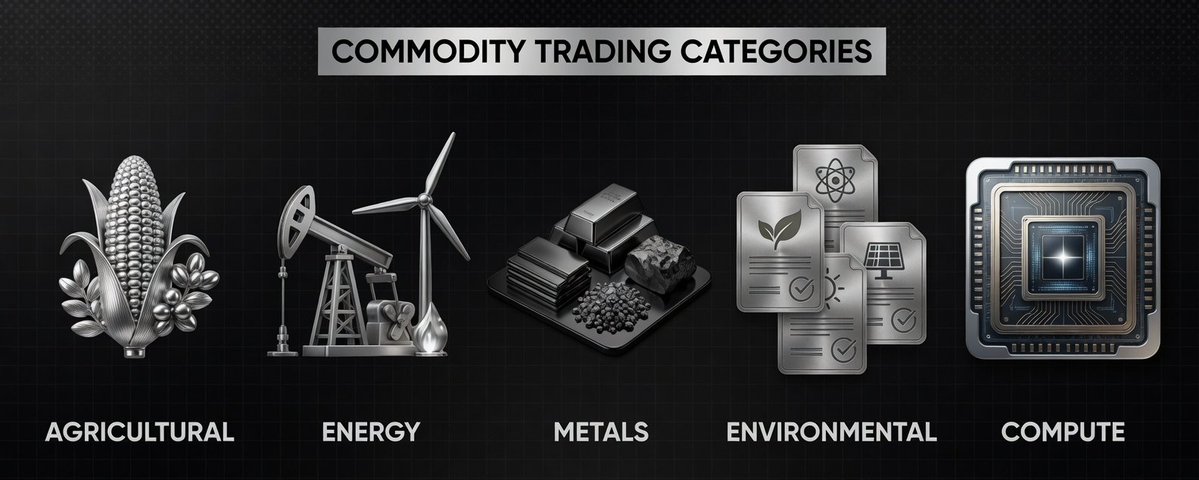
## 次のコモディティ市場:コンピュートのための金融インフラを構築する
私たちはまだ、コンピュートの供給制約市場に生きている。しかし私の見方では、コンピュートは石油と同じようにコモディティになる。
そして石油と同じように、買い手と売り手がコンピュートを取引するための流動的な市場を可能にする市場インフラが必要になる。成熟したコンピュート市場がどんな姿になるかを理解したければ、他のすべてのコモディティ市場がどのように発展してきたかを見ればいい。
ICEとCMEは世界で最も重要な2つの取引所運営会社で、それぞれ現在約910億ドルと1,040億ドルの時価総額を持つ。S&P Global(そのPlattsビジネスはコモディティ市場全体でベンチマーク価格の提供を担う)は約1,340億ドルの時価総額だ。公開市場のベンチマーク層となる強力なインデックスライセンスビジネスを構築したMSCIは約420億ドルだ。
私は最近、@OrnnExchangeのCTOである @wayne_nelmz と、コンピュートの未来について対話する機会を持った。「メガワットをトークンにするのは非常に難しい。効率的ではない」と彼は語った。その非効率性こそが、生のインフラから有用なAIアウトプットへの道程だ。ワイルドウェストの状況だ。そしてワイルドウェストは歴史的に、最も価値ある金融インフラが構築され、混沌に秩序をもたらす場所だった。
---
## 現在の市場
コンピュートへの連鎖は、土地を所有する者から始まる。次にデータセンターを建てる者。次に建設を可能にする資本を提供する貸し手。次に施設をリースするネオクラウドのテナント。次に企業に再販するクラウドサービスプロバイダー。次にそのコンピュートをトークンに変えるAI企業。この連鎖の各リンクは隣のリンクを見ながら問いかける:このエンドユーザーが実際に支払うかどうか信頼できるか?
「商業不動産に似ています。アパートを建てた人がオーナーにリースし、オーナーは運営上のリスクを持つ。オーナーが気にするのは最終的な入居者の信用力だけです。問題は(AIインフラの場合)ほとんどの入居者が新参者であることだ」とWayneは言った。「創業1年未満の企業が膨大なコンピューティングニーズを抱えている。実質的には、保証人なしにニューヨークでアパートを借りようとする新卒者と同じ状況です。」
今日、誰かがデータセンターを建てられる唯一の方法は、ハイパースケーラーが保証人として入ることだ。ハイパースケーラーが親として賃貸契約に共同署名している状況だ。
これはスケールしない。そしてますます脆くなっている。
ハイパースケーラーのバランスシートは無限ではないし、エコシステムの残りとは利益が一致していない。これらの企業には独自のアジェンダがある。当然のことながら自社利益を優先する。一部がIPOに近づいたり、設備投資に関する投資家の期待を管理したりするにつれて、保証人としての役割を絞る圧力が高まっている。
「プライベートクレジット会社は、最も有名なAI企業に対してさえ、融資の条件をより厳しくしています。」そしてそれが食物連鎖の頂点で起きているなら、その下で何が起きているか想像してほしい。
「小規模なプレイヤーがデータセンターに行っても、笑われるだけです。バランスシート上の資金も信用力も不十分です。」加えて、1年だけ借りる選択肢はなく、ほとんどが3〜5年のロックインを強いられる——これは新規参入者にとって事実上不可能だ。
---
## 構造的なミスマッチ
今日の市場には構造的なミスマッチがある:実質的に2つのトランシェが互いに出会えない状況だ。
一方では、投資適格の供給(ハイパースケーラーが支援するデータセンター)が、非常に小さなプールの投資適格バイヤーを取り合っている。大手データセンター開発者はすべて、同じわずかなハイパースケーラーとの取引を勝ち取るために料金を下げようとしている。「皆が問いかけています。どうすれば料金をGoogleにとって魅力的にできるか?そのためGoogleは現在、巨大な価格決定力を持っています」とWayneは言った。
一方には、投資不適格なその他全員がいる。テナントを得られない小規模データセンター。5年のオフテイクに署名できないため容量を確保できない小規模AI企業。
「これらのバイヤーはセラーを信頼せず、セラーもバイヤーを信頼しない。低層の需要が欲しいのは高層の供給だけです」とWayneはまとめた。
---
## 市場への2つの道
このギャップを埋める方法は2つあり、成熟したコモディティ市場にはどちらも備わっている。
**第1の道は、需要のロングテールを信用力ある存在にすること。** 需要を集約し、格付けし、個々のバイヤーが単独では資金調達に値しなくても全体として資金調達可能に見える分散バスケットにパッケージ化することで実現できる。これは証券化のプレイブックだ——単独では資本の対象にならないものを、対象になるものに構造化する。
**第2の道は、ヘッジを制度化すること。** オンデマンド市場を構築し、参照価格を公表し、先物とデリバティブを立ち上げ、データセンター・ネオクラウド・貸し手が逆価格変動から身を守れるようにする。これはコモディティのプレイブックだ——リスクを排除できないなら、少なくともその価格を設定し移転できる。
今日、コンピュートにはどちらの道もスケールで利用できない。
---
## リスク軽減を通じた信頼の構築
これらの道を作るために、コンピュートはリスク軽減ツールが必要だ:ベンチマーク・先物・残存価値保証・集約を通じたクレジットエンハンスメント。これらは、石油と株式を非流動的な相対取引市場から世界で最も深く効率的な市場に変えたものと同じ要素だ。
「すべては信頼にかかっています。投資をより安全にしなければならない。どうやって?リスク軽減ツールを提供しなければならない」とWayneは言った。
この機会について話すと耳にする異論のひとつは、GPUはベンチマークを作るほど代替可能でないというものだ。すべてのクラスターが、ハードウェア世代・ネットワークファブリック・電力密度・ロケーション・信頼性の点で独自だ。これほど変動するものについて、単一の参照価格を公表できるか?
しかしこれは他のどのコモディティとも変わらない。「石油・銀・金・小麦——すべて異なるグレードがあります。もちろんGPUは他のコモディティより更に差異が大きく、言うなれば雪の結晶のようなものです。でも最低スペックを定義してその範囲内でインデックス化すればいい」とWayneは言った。
「世界で最も精緻なインデックスを作ることを心配する必要はありません。良いインデックスを作りたいだけです」とWayneは付け加えた。「これは直感に反して聞こえるかもしれないが、リスク軽減と管理を促進するのに十分なだけあればいい。」
言い換えれば、目標は異なるエクスポージャーを持つ2つのカウンターパーティが取引できる参照点を構築することだ。
一部が試みている代替アプローチは、すべての粒度を抽象化することで代替可能性を強制することだ(つまり、どこにあっても何に接続されていても、すべてのH100を同等として扱う)。私はこれが正しいアプローチだとは思わない。バイヤーが実際のニーズを指定できなくなるほど詳細が抽象化されてしまうからだ。
---
## エンドステートはどうなるか
もちろん、今日もこれのバリエーションに取り組んでいる企業はある。Nvidiaが最も明らかなものだ:保証人としての役割を通じて、事実上市場を引き受けている。しかし彼らは長期的なソリューションではない。コモディティ市場のインフラ層は中立でなければならない。Nvidiaが所有するコンピュート市場はAMDに決して信頼されないだろう——ハイパースケーラーが所有するベンチマークが、それが競合するネオクラウドに決して信頼されないのと同様に。S&PやMSCIのような既存プレイヤーについては、データも・ネオクラウドとの関係も・取引フローも持っていない。彼らはいずれ買収によって参入するだろうが、ゼロから構築することはないだろう。
したがって、コンピュート向けの中立的な市場インフラを構築する機会が存在する。それは他のコモディティ市場と同様の道をたどるだろう。
コンピュートはやがて、長期の相対取引ではなくオンデマンドで調達される、より流動的な市場になる。参照価格が継続的に公表される。未使用の予約のセカンダリ市場が生まれる。クレジットエンハンスされたバスケットが小規模AI企業のトップ層供給へのアクセスを支援する。
Wayneによれば、これを実現するために「最終的に必要なのは市場への信頼の構築です」。
---
*著者注:LLMは軽微なコピー編集(スペル・文法・明瞭さ)のみに使用した。内容・意味・トーン・構成は変更されていない。*
AIインフラコンピュート市場金融インフラbusiness-model
コンピュートは次のコモディティ市場になる:石油・金融インフラの歴史に学ぶAIインフラの未来
11814
原文を表示 / Show original
Annelies Gamble
@AnneliesGamble
The Next Commodity Market: Building the Financial Infrastructure for Compute
11
14
118
10K
We’re still living in a supply constrained market for compute. But my belief is that compute will become a commodity, just like oil.
And just like oil, we need market infrastructure to enable a liquid market for buyers and sellers of compute to transact. If you want to understand what a mature compute market could look like, look at what every other commodity market became.
ICE and CME, two of the world’s most important exchange operators, are worth approximately $91 billion and $104 billion respectively today. S&P Global, whose Platts business helps provide benchmark pricing across commodity markets, is worth about $134 billion. MSCI, which built a powerful index licensing business around becoming a benchmark layer for public markets, is worth about $42 billion.
I recently sat down with @wayne_nelmz, the CTO of @OrnnExchange, to talk about where he sees the future headed for compute. "Turning a megawatt into a token is very hard. It's not very efficient," he told me. That inefficiency is the path from raw infrastructure to useful AI output. It's a wild west. And wild wests, historically, have been where the most valuable financial infrastructure gets built, bringing order to chaos.
The current market
The chain to compute starts with whoever owns the land. Then the data center builder. Then the lenders, who provide the capital that makes the build possible. Then the neocloud tenants who lease the facility. Then cloud service providers who resell to enterprises. Then the AI companies that turn that compute into tokens. Each link in the chain is looking at the one next to it and asking: can I trust this end user to actually pay?
"It’s like in commercial real estate, the person who builds the apartment building is leasing it to a landlord, and the landlord has some operational exposure. The landlord only cares about the creditworthiness of the end resident,” Wayne said. “The problem is that (for AI infrastructure) most of the residents are new.”
“We have all these companies that aren’t even a year old that have huge computing needs. They're effectively the equivalent of a new grad in New York looking to rent an apartment without a guarantor."
The only way anyone gets a data center built today is if a hyperscaler steps in as the guarantor. They're the parents co-signing the lease.
This doesn't scale, and it's also becoming more and more fragile.
Hyperscaler balance sheets are not infinite, and they are not aligned with the rest of the ecosystem. These companies have their own agendas. They're selfish, as they should be. And as some of them approach public markets or manage investor expectations around capex, the pressure to throttle their guarantor role is intensifying.
"Private credit firms are becoming more particular about the loans they give, even to some of the most well known AI companies." And if that's happening at the top of the food chain, imagine what's happening below it.
“If smaller players go to a data center, they're just going to get laughed at. They don't have enough money on their balance sheet or creditworthiness.” Not to mention, there aren’t options to rent just for one year so most have to lock in for 3-5 years, which is basically impossible for these new entrants.
The structural mismatch
The market today has a structural mismatch: there are essentially two tranches that can't meet each other.
On one side, you have investment-grade supply (hyperscaler-backed data centers) fighting over a tiny pool of investment-grade buyers. Every major data center developer is trying to lower their rates to win deals with the same handful of hyperscalers. “Everyone is asking, how can I make my rates more attractive so Google will buy? So, Google has huge pricing power right now," Wayne said.
On the other side, you have non-investment-grade everyone else. Smaller data centers who can't get tenants because no one trusts them. Smaller AI companies who can't get capacity because they can't sign five-year offtakes.
"None of these buyers trust these sellers, and vice versa; the only thing the low-tier demand wants is the high-tier supply," Wayne summarized.
Two paths to a market
There are two ways to close this gap, and any mature commodity market has both of them.
The first path is to make the long tail of demand creditworthy. You can do this by aggregating demand, rating it, packaging it into diversified baskets that as a whole look financeable even if individual buyers don't. This is the securitization playbook: take something that doesn't qualify for capital on its own and structure it into something that does.
The second path is to institute hedges. Build an on-demand market, publish reference prices, launch futures and derivatives so that data centers, neoclouds, and lenders can protect themselves against adverse price movements. This is the commodities playbook: if you can't eliminate the risk, you can at least price it and transfer it.
Today compute has neither path available at scale.
Building trust through risk mitigation
To create these paths, compute needs risk mitigation tools: benchmarks, futures, residual value guarantees, and credit enhancement via aggregation. These are the same things that turned oil and equities from illiquid, bilateral markets into the deepest, most efficient markets in the world.
"It's all about trust. We have to make it a safer investment. And how do you do that? You have to provide risk mitigation tools,” Wayne said.
One objection I hear when I talk to people about this opportunity is that GPUs aren't fungible enough to benchmark. Every cluster is unique due to different hardware generation, different networking fabric, different power density, different location, different reliability. How can you publish a single reference price for something that varies so much?
But this is no different from any other commodity. "Oil, Silver and gold, wheat. They all have different grades. Of course GPUs are arguably more different, more like a snowflake, so to speak, than any other commodity class," Wayne said. But that just means you define minimum specs and index within those bands.
"We don't have to worry about making it the most granular index in the world. We just want to make a good enough one,” Wayne said. Adding that, “this might sound counterintuitive, but it just needs to be good enough to facilitate any risk mitigation and management."
In other words, the goal is to build a reference point against which two counterparties with different exposures can transact.
There's an alternative approach some are trying, which is to force fungibility by abstracting away all the granularity (aka treating every H100 as interchangeable regardless of where it sits or what it's connected to). I don’t think this is the right approach because you abstract away too many details such that buyers can't specify their actual needs.
What the end state looks like
There are, of course, companies doing variations of this today. Nvidia is the most obvious one: through its guarantor role, it's effectively underwriting the market. But they aren't the long-term solution. The infrastructure layer in any commodity market has to be neutral. A compute market owned by Nvidia would never be trusted by AMD, just like a benchmark owned by a hyperscaler would never be trusted by the neoclouds it competes with. And as for the incumbents like S&P and MSCI, they don't have the data, the neocloud relationships, or the transaction flow. I think they'll eventually acquire their way in, but they're not going to build this from scratch.
There is thus an opportunity to build neutral market infrastructure for compute, which will follow a similar path as other commodity markets.
Compute will eventually become a more liquid market where capacity is procured on demand rather than primarily through long-dated bilateral contracts. Reference prices will be published continuously. Secondary markets will emerge for unused reservations. Credit-enhanced baskets will help smaller AI companies access top-tier supply.
According to Wayne, to make this happen, “it’s ultimately about building trust in the market.”
Author’s note: An LLM was used for light copy editing only (spelling, grammar, and clarity). Content, meaning, tone, and structure remain unchanged.
Want to publish your own Article?
Upgrade to Premium
12:55 AM · Apr 22, 2026
·
10.9K
Views
11
14
118
183
Read 11 replies