
記事一覧へ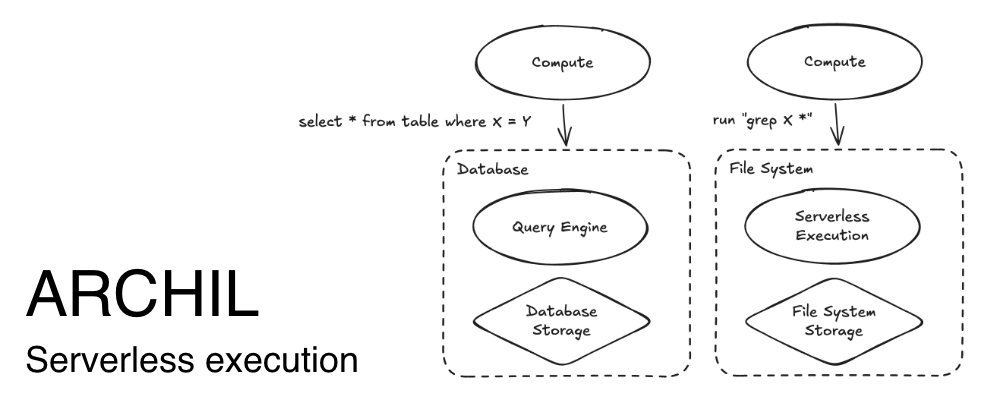
オンボーディング時に、ほぼすべての顧客がクラウドからのエグレス料金について私に聞いてくる。これは理にかなっている。パブリックサービス(あなたのクラウドアカウントで実行していないもの)は、実際のサービスが同じクラウドリージョンにあっても、通信する際に完全なエグレス料金がかかるからだ。残念だが、最大手の顧客向けにはこれを回避するためのプライベートネットワーキングオプションをサポートしている。
数ヶ月前、@nikitabaseとDatabricksの買収について話していたとき、彼の顧客もエグレスについて怒っているはずだとどう対処しているかを尋ねた。彼は「一度も話題に上ったことがない」と言い、それが本当に引っかかった。なぜ最大のサーバーレスデータベースプロバイダーが顧客にエグレスを心配させていないのか?私はそれを歩み去り、データベースがIOPS重視でスループット重視ではないという一種のまぐれとして片付けた。
少し後に、@richardartoulとArchilについて話していたとき、彼が(自分から)こう言った。「あなたたちはWarpStreamと同じ問題を抱えているよね?みんなエグレスを心配している。なぜなら顧客はサービスに入れた全バイトを1:1で読まなければならないから。どうやって解決するの?」そう、これを理解してくれる人だ。そして真実は彼の言葉の中にあった。
「顧客はサービスに入れた全バイトを1:1で読まなければならない。」その瞬間、私は悟った。
データストレージの超シンプルなケースで考えてみよう:いくつかのフィールドで検索する場合。データベースでは「select * from table where X = Y」と書くが、ファイルシステムでは...そう、grepを使う。
明らかに、この二つには大きな違いがある。ファイルシステムでgrepを使うと、あなたのマシンは検索しているすべてのファイルをダウンロードし、(メモリ内で)マッチするファイルを探す。(余談:シングルスレッドなので、それもまた素晴らしい)
データベースで「select .. where」文を実行すると、クライアントはそれをデータベースに送る。データベースには内部にコンピュートが埋め込まれており、同様のことを行うが、よりスマートだ。関連するインデックスを特定し、クエリの最適バージョンを構築しようとし、そして重要なことに、あなたが要求した特定のデータだけを送り返す。
それは速そうに聞こえるだけでなく、あなたが実行しているコンピュートとストレージシステムの間のネットワークトラフィックも大幅に少ない。その結果、ファイルシステムでは100GBのエグレスになるかもしれないものが、データベースでは2KB未満になる可能性がある。
データベースはデータを直接転送していないからだ。データとどう対話するかの命令を転送している。
この事実の結果が、私たちがサービスのレイテンシを下げることにこれほど力を入れている理由であり、数百マイクロ秒のネットワークラウンドトリップがある場合にのみサービスの使用を推奨する理由だ。しかし、なぜファイルシステムはこのように制限されているのかと聞く価値がある。データを生でそのまま転送するのではなく、命令を送ることができる方法はないのか?
実際にあり、私たちがすでにファイルシステムとやり取りするために使っている共通言語がある。それはbashインターフェースを持つLinuxコンピュータだ。
クライアントがファイルシステムの状態を取得または操作する完全な命令、つまりbashコマンドを送れる世界を想像できる。そのコマンドをファイルシステム自体の内部で実行し、ユーザーが気にする結果だけを返す。
データベースの場合と同様に、この実行をどのように行うかについて多くの選択肢がある。bashを最適化して多数の内部コンピュートに分散させるプランナーを実装することもできるし、ストレージが実際に存在するサーバー上にbashをコロケートしてクエリのレイテンシを削減することもできる。
大きな勝利:顧客はエグレス、サービスへのレイテンシ、インスタンスのサイジングを心配する必要がなくなる。
これがArchilのサーバーレス実行機能で私たちが実現しようとしている未来だ。私たちは弾力的でパフォーマンスが高く、使いやすいだけでなく、顧客が望む方法で機能する最初のファイルシステムを構築している。コンピュートをシステムのファーストクラスプリミティブとして埋め込むことで。
サーバーレス実行は、開発者がステートフルシステムを構築する方法を根本的に簡素化すると期待している。エージェント構築の爆発は、ほとんどの開発者が初めてステートフルシステムについて考えなければならない最初の機会だ。会話履歴、プロンプト、メモリ、コンテキストの管理はすべてステートフルな問題だ。サーバーレス実行はこのスタックの重要な部分になるだろう。
サーバーレス実行は今日、すべてのArchilファイルシステムにロールアウトされている。console.archil.comで新しいディスクを作成して始めよう。
agent-opsharness-designai-thinking
ファイルシステムへのコンピュート埋め込み
27615
原文を表示 / Show original
When onboarding, almost all of our customers ask me about egress fees from the clouds. This makes sense, any public service (not running in your cloud account) gets charged full egress when you talk to it -- even when the actual service is in the same cloud region. Lame, but we support private networking options for our largest customers to avoid this.
A couple of months ago, I was talking to @nikitabase about the Databricks acquisition, and I asked him how he dealt with the fact that his customers must be angry about egress too. He told me "it's never come up", which really struck me. Why is it that the largest serverless database provider doesn't have customers worried about egress? I walked away and wrote it off as some kind of fluke where databases are very IOPS heavy but not very throughput heavy.
A little while later, I was talking to @richardartoul about Archil, and he said to me (unprompted) -- "You guys have the same problem as WarpStream, huh? Everyone is worried about egress because customers have to read 1:1 every byte they put into the service. How do you solve it?" YES. Someone who gets it, and the truth sat exactly in what he said.
"Because customers have to read 1:1 every byte they put into the service." At that moment, Hunter became enlightened.
Let's take a super-simple case in data storage: doing search through some fields. On a database, you might write "select * from table where X = Y", and in a file system you would... that's right -- you'd use grep.
Now, obviously, there's a huge difference between these two things. When you use grep on the file system, your machine literally downloads every file that you're searching through and (in its memory) pokes around to find the files that match. [aside: it's also single threaded, so that's just great]
When you execute a "select .. where" statement on a database, your client... sends it to the database. The database embeds compute inside of it that does a similar thing, but smarter -- identifies what indexes are relevant, tries to build the most optimal version of the query, and -- importantly -- only sends back the specific data that you asked for.
Now, not only does that sound faster, it's also significantly less network traffic between the compute that you're running and the storage system. As a result, what might be 100 GBs of egress on the file system could be <2 KBs on a database.
Because the database isn't transferring the data directly. It's transferring instructions for how to interact with the data.
The net result of this fact is why we work so hard to lower the latencies on our service, and we only recommend that people use our service when they have a network round trip in hundreds of microseconds. It's worth asking though: why is the file system crippled like this? Is there any way for the file system to manage sending instructions instead of just transferring the data raw?
In fact, there is, and we already have a lingua franca that we use to interact with file systems -- it's a Linux computer with a bash interface.
We could envision a world in which the client is able to send us a complete instruction -- a bash command -- that either retrieves or manipulates the state of the file system. We could then execute that inside of the file system itself and only return the result that the user cares about.
Just like the database case, this gives us TONS of options for how we do this execution. We could implement a planner to optimize the bash and fan it out across lots of internal compute, we could colocate the bash on the servers where the storage actually lives locally to reduce the latency of the query, and more.
The big win though: the customer doesn't need to worry about egress, latency to our service, or sizing their instance.
This is the future that we're delivering on with Archil's serverless execution feature. We are building the first file system that is not only elastic, performant, and simple to use. We're building the first file system that works how customers want, by embedding compute as a first-class primitive into the system.
We expect that serverless execution will radically simplify how developers build stateful systems. The explosion in building agents marks the first time that most developers have to think about stateful systems: managing conversation history, prompts, memory, and context are all stateful problems. Serverless execution will become a vital part of this stack.
Serverless execution is rolling out to all Archil file systems today. Create a new disk at console.archil.com to get started.