
記事一覧へ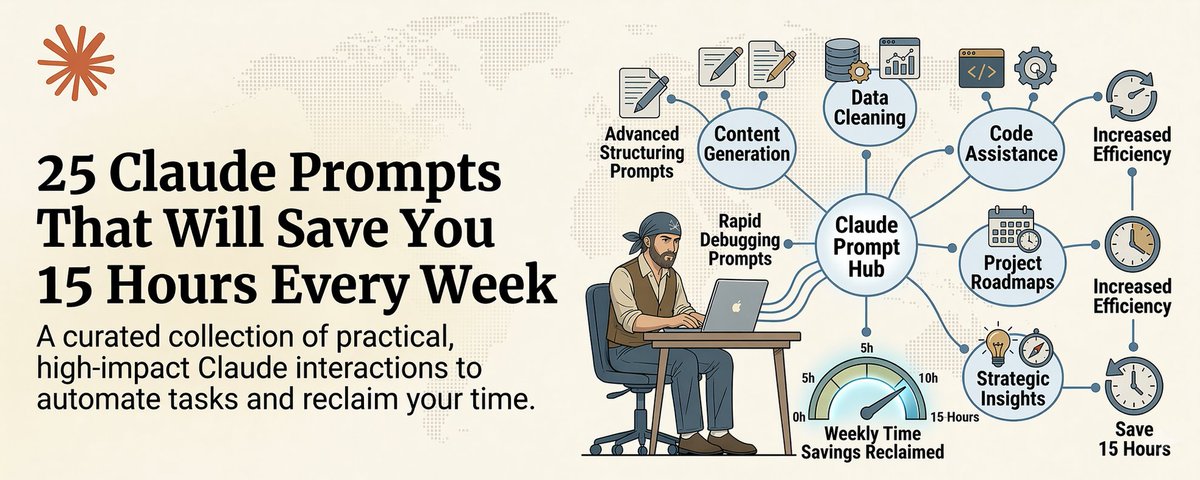
## 私が毎日テストし続けた25のプロンプト。使い続けているのはこれだけです。
保存してください :)
ほとんどのプロンプトリストはギミックで溢れています。「海賊になりきって量子物理学を説明して」クールなパーティートリック。実用的な価値はゼロ。
これらは違います。このリストの全てのプロンプトは、毎週あなたの本当の時間を消費する本当の問題を解決します。コピーしてください。貼り付けてください。時間を取り戻してください。
## ライティング & コンテンツ(1〜7)
**01. 初稿キラー**
```
[タイプ:ブログポスト / ニュースレター / 記事]についての[トピック]の初稿が必要です。
オーディエンス:[彼らが誰か]
トーン:[具体的なトーン — 例:直接的で少し反骨的]
長さ:[文字数]
こう聞こえないように:汎用AI、企業の専門用語、LinkedInインフルエンサー
これを含まないように:フィラーフレーズ、不必要な注意書き、「今日の急速に変化する世界では」
私のライティングスタイルの例:
[最高の以前の作品を貼り付け]
例のボイスとエネルギーに合わせる。完全な初稿を書いてください。
```
なぜ機能するか:ネガティブな制約がAI臭を消す。例はClaudeにあなたのボイスを説明より上手く教える。このプロンプト1つで空白ページを見つめる90分が置き換わりました。
**02. スレッド拡張機**
```
このアイデアを10投稿のX/Twitterスレッドに変換:
[アイデアまたはホットテイクを貼り付け]
ルール:
- 投稿1は好奇心を呼び起こすか大胆な主張をするフックでなければならない
- 各投稿は最大1〜3文
- 曖昧な主張ではなく具体的な例と数字を含める
- 投稿10には明確な行動喚起を含める
- ハッシュタグなし。絶対に必要でなければ絵文字なし
- こう聞こえないように:モチベーションスピーカーかLinkedInグル
```
なぜ機能するか:構造的な制約が論理的なナラティブを強制する。ネガティブな制約がタイムラインの他の全てのAIスレッドのように聞こえないようにする。
**03. コンテンツ再利用機**
```
長文コンテンツが1つあります。複数の形式に再利用してください。
元のコンテンツ:
[記事 / ニュースレター / トランスクリプトを貼り付け]
作成:
1. 5つの独立したツイート(各自が単独で機能するべき、記事の引用だけではなく)
2. 2つのLinkedIn投稿(プロフェッショナルだが退屈ではない、各最大200ワード)
3. 3つのInstagramキャプションオプション(カジュアル、会話的、150ワード以内)
4. 1つのメールティーザー(100ワード以内、好奇心を誘う件名)
全形式でボイスを一貫させる。長さとトーンを各プラットフォームに適応させるが、核心メッセージは同じ。
```
なぜ機能するか:1時間の執筆が4プラットフォームで1週間分のコンテンツになる。「独立した」指示が全ツイートが記事から引っ張られた文だけという怠慢な抽出を防ぐ。
**04. ヘッドラインマシン**
```
このトピックのヘッドライン変形を20個生成:[トピック]
以下のフレームワークを使用(各フレームワークで少なくとも2つ):
- 好奇心ギャップ:「なぜXはYをするのか(そしてZにとって何を意味するか)」
- 具体的な数字:「7つの方法...」または「200のツールをテストして...」
- ハウツー:「YなしでXする方法」
- 反骨的:「Xは間違っています。理由はこちら」
- ソーシャルプルーフ:「私/私たちはどのようにXを達成したか」
- 「私はしたい」形式:「私は[意欲的な目標]したい(フルコース)」
上位5つを選んで、それぞれがなぜ誰かのスクロールを止めるかを説明してください。
```
なぜ機能するか:ほとんどの人は1つのヘッドラインを書いて望みをかける。これは実証済みのフレームワークで20のオプションを生成し、どれが実際にスクロールを止めるかをClaudeに評価させる。
**05. メールシーケンスライター**
```
[製品/サービス]の5通のウェルカムシーケンスを書いてください。
ターゲットオーディエンス:[誰]
主なペインポイント:[最大の問題]
シーケンスの目標:[メール5までに彼らにしてほしいこと]
各メールに提供:
- 件名(50文字以内、好奇心を誘う)
- プレビューテキスト(90文字以内)
- 本文(200ワード以内、会話的、1つの明確なCTA)
- 送信タイミング(登録後の日数)
- A/B件名のバリエーション
ルール:
- メール1はすぐに価値を提供し、販売しない
- メール2はペインポイントに接続するストーリーを語る
- メール3はソリューションをさりげなく紹介する
- メール4はソーシャルプルーフかケーススタディを提供する
- メール5は緊急性を持って直接的なお願いをする
各メールはマーケティング部門からではなく人から来たように感じるべき。
```
なぜ機能するか:このプロンプト1つがコピーライターが$500〜$2,000で生産するものを置き換える。構造は各メールが受信箱を埋めるだけでなく戦略的な目的を果たすことを確保する。
**06. SEOコンテンツブリーフ**
```
キーワードをターゲットにしたブログポストの完全なコンテンツブリーフを作成:[キーワード]
以下を含む:
1. 推奨タイトル(キーワードを自然に含む)
2. メタディスクリプション(155文字以内、キーワード含む)
3. 提案URLスラッグ
4. ターゲット文字数
5. H2とH3見出しを含むアウトライン
6. 全体に自然に含める5つの関連キーワード
7. 3つの内部リンクの機会(アンカーテキストとリンク先を提案)
8. 信頼性のための2つの外部ソース提案
9. フィーチャードスニペットの機会(スニペットを獲得しやすいセクションをフォーマット)
ブリーフは追加のリサーチなしにどのライターでも記事を作成できるほど詳細であるべき。
```
なぜ機能するか:2時間のリサーチと計画セッションを2分のプロンプトにする。フィーチャードスニペットセクションだけで価値があります、ほとんどのライターは最適化しないから。
**07. ボイスクローナー**
```
以下のライティングサンプルを分析して私のライティングボイスを抽出:
[最高の作品を2〜3つ貼り付け]
以下を含む「ボイスプロファイル」を作成:
- 文章の長さパターン(短、中、長、または混在)
- 語彙レベル(シンプル、テクニカル、アカデミック)
- トーンの特質(5つの形容詞でリスト)
- 構造的な習慣(段落の長さ、サブヘッドの使用、リスト対散文)
- 私がよく使うフレーズやパターン
- 私が絶対にしないこと(フォーマル対カジュアルのマーカー)
- エネルギーレベル(落ち着いた、強烈、緊急、会話的)
それから[どんなトピックでも]について、この正確なボイスプロファイルを使って200ワードのサンプル段落を書いてください。実際のライティングと比較して精度を確認します。
```
なぜ機能するか:これを一度実行してコンテキストファイルとして保存。以降の全プロンプトがインターネット上の他のAI出力のように聞こえる代わりに初回からあなたのボイスを正しく得られる。
## リサーチ & 分析(8〜14)
**08. ミーティング準備ブリーフ**
```
[時間]に[会社]の[人物名]とミーティングがあります。
以下をカバーする1ページのブリーフを作成:
1. 彼らの背景(役割、キャリアのハイライト、関連経験)
2. 彼らの会社(何をしているか、最近のニュース、現在の課題)
3. 彼らからの最近の公開発言、記事、ソーシャル投稿
4. ミーティングトピックに関連する3つのトーキングポイント:[トピック]
5. 彼らに尋ねる3つのスマートな質問
6. ラポールを構築するための1つの潜在的な共通点または共有利益
ミーティング前に5分で読める走査可能なドキュメントとしてフォーマット。
```
なぜ機能するか:全ミーティング前の30分のLinkedInストーキングとGoogle検索を置き換えた。「共通点」セクションだけで他のどの準備ステップよりも多くの扉を開いた。
**09. 意思決定マトリックス**
```
[決断]について決断を下す必要があります。
私のオプション:
1. [オプションA]
2. [オプションB]
3. [オプションC — 任意]
私の優先事項(ランク付け):
1. [最重要要素]
2. [2番目に重要]
3. [3番目に重要]
各オプションについて:
- 各優先要素で1〜10でスコア付け
- 上位2つのリスクをリスト
- 上位2つの優位点をリスト
- このオプションが最善になるために何が真実でなければならないかを特定
それから推論とともに推奨オプションを3文で教えてください。
曖昧にしないでください。1つを選んで擁護してください。
```
なぜ機能するか:「曖昧にしないで」という指示が全てです。それなしだと、Claudeは誰の役にも立たないバランスの取れた分析を出す。それで明確な推奨が得られ、従うか議論できる。
**10. 競合分析**
```
競合インテリジェンスアナリストとして[競合名 / URL]を分析してください。
以下をカバー:
1. 何を誰に売っているか(セグメントについて具体的に)
2. 価格モデルと概算価格帯
3. ポジショニング(自己説明の仕方と市場がどう見るか)
4. 最強の機能または差別化要素
5. 最大の弱点またはギャップ
6. 最近の動き(製品ローンチ、採用、パートナーシップ、資金調達)
7. 彼らが私たちより得意なこと:[あなたの会社/製品]
8. 私たちが彼らより得意なこと
末尾に:彼らの弱点に基づいて私たちが利用できる3つの戦略的機会。
事実情報のみを使ってください。主張について自信がない場合は未確認とフラグを立てください。
```
なぜ機能するか:競合リサーチの一日中分を置き換える。「未確認とフラグを立てる」指示がClaudeが競合について自信を持って作り話をするデフォルトの失敗モードを防ぐ。
**11. 書籍プロセッサー**
```
[著者]の[書籍タイトル]を読み終えました。
これらのセクションで構造化されたサマリーを作成:
1. 核心的テーゼ(最大3文)
2. 5つの最重要なアイデア(それぞれ2〜3文、著者ではなく自分の言葉で)
3. 著者が行う最強の論点(そしてなぜ強いのか)
4. 著者が行う最弱の論点(そしてなぜ弱いのか)
5. [私の仕事 / ビジネス / 人生]に適用できる3つの具体的な方法
6. 保存する価値のある重要な引用(最大5つ)
7. 誰がこれを読むべきで誰がスキップすべきか
信号だけが欲しい忙しいエグゼクティブにブリーフィングするように書く。
```
なぜ機能するか:6時間の本が10分の実行可能なブリーフになる。「私の具体的な状況に適用する」セクションが理論的でなく実践的にする。
**12. データエクスプレイナー**
```
これがデータセットです:
[データを貼り付けまたは説明]
分析して:
1. 3つの最重要なトレンド(具体的な数字で)
2. 調査する価値のある異常値または外れ値
3. 変数間の相関関係(存在する場合)
4. このデータが次に何をすべきかを示すもの(2〜3つの推奨)
5. このデータが教えてくれないこと(制限とブラインドスポット)
2つの形式で発見を提示:
- 30秒しかない人のための3文エグゼクティブサマリー
- 5分ある人のための詳細な内訳
データから結論を引き出すには不十分な場合は、推測するのではなくそう言ってください。
```
なぜ機能するか:2つの形式の出力が秘訣。自分用の素早い答えと詳細な質問をするステークホルダー用の詳細バージョンが得られる。「このデータが教えてくれないこと」セクションが過信した決断を防ぐ。
**13. プロセス文書化機**
```
私が定期的に行うプロセスを説明します。構造化された標準作業手順書にしてください。
私のプロセス:
[日常的な言葉で行うことを説明]
SOPを作成:
1. 目的(1文——このプロセスが存在する理由)
2. 頻度(どれだけの頻度で実行するか)
3. 前提条件(開始前に何が整っている必要があるか)
4. ステップバイステップの手順(番号付き、具体的、曖昧さなし)
5. 品質チェック(各ステップが正しく完了したか確認する方法)
6. 避けるべき一般的なミス
7. 完了の時間見積もり
新入社員が初日に質問なしで従えるようにフォーマット。
```
なぜ機能するか:誰もが頭の中に生きていて一度も文書化したことのないプロセスを持っている。このプロンプトはそれらを人間に委任またはAIエージェントで自動化できる形式で抽出する。
**14. 仮定破壊機**
```
[プロジェクト / 決断 / 戦略]を計画しています。
私の仮定:
1. [仮定1]
2. [仮定2]
3. [仮定3]
各仮定について:
- どの程度の自信が持てるか(高 / 中 / 低)とその理由
- この仮定が成立するために何が真実でなければならないか
- この仮定が間違っていた場合の最悪シナリオ
- コミットする前にそれを検証または否定するための1つの素早い方法を提案
それから、私がリストしなかった2つの仮定を特定してください。それぞれを説明してください。
正直かつ直接的に。悪いニュースを和らげないでください。
```
なぜ機能するか:これがリストで最も過小評価されたプロンプトです。隠れた仮定セクションが一度ならず悪い決断を単独で防いだ。私たちは誰もが自分自身のブラインドスポットに盲目です。
## プロダクティビティ & ビジネス(15〜21)
**15. 週次レビューエンジン**
```
今週起きたこと:
完了:[完了したことをリスト]
進行中:[進行中のことをリスト]
ブロック:[詰まっていることと理由をリスト]
勝利:[勝利またはマイルストーンをリスト]
これに基づいて:
1. 今週最もインパクトのあった活動は何でしたか?
2. 時間を消費したが意味のある結果を生まなかった活動は何ですか?
3. ブロッカーにどんなパターンが見えますか?
4. 来週何を優先すべきか(上位3つだけ)?
5. 何をやめるか委任すべきか?
直接的に。時間を費やしたことが無駄であれば、そう言ってください。
```
なぜ機能するか:30分の代わりに5分での金曜日レビュー。「直接的に」指示がClaudeが全てを褒めるのを防いで実際に有用な自己評価を強制する。
**16. クライアント提案ジェネレーター**
```
[クライアント名]向けのプロジェクト提案の草案を作成してください。
プロジェクト:[何を構築/提供するか]
クライアントの主な問題:[彼らが必要と言ったこと]
タイムライン:[予想タイムライン]
予算範囲:[あなたの価格範囲]
構造:
1. 問題の理解(耳を傾けたことを示す——3文)
2. 提案するソリューション(何を構築/提供するか)
3. スコープ(含まれるものと明示的に含まれないもの)
4. マイルストーン付きタイムライン
5. 投資(支払いスケジュール付き価格)
6. 次のステップ(明確な次のステップとCTA)
トーン:プロフェッショナルで自信があるが堅くはない。クライアントはロボットではなく有能なパートナーを雇っているように感じるべき。
提案全体は800ワード以内。簡潔さは自信を示す。
```
**17. コールドアウトリーチパーソナライザー**
```
[会社]の[人物]に[あなたが提供するもの]について連絡を取りたい。
彼らの役割:[タイトル]
会社の内容:[簡単な説明]
彼らについての関連情報:[最近の投稿、記事、実績、または会社のニュース]
コールドメールを書いてください:
- 彼ら特有の何かで始まる(「これがよく見つかりましたように」ではなく)
- 3文以内で要点を述べる
- 私が何をするか、なぜ彼らの具体的な状況に重要かを明確に述べる
- 低摩擦なCTA(「30分のミーティングを予約しましょう」ではなく)
- 合計長さ:100ワード以内
こう聞こえないように:テンプレート、営業ピッチ、LinkedInコネクションメッセージ。
こう聞こえるように:関連することに気づいて連絡した賢い人。
```
なぜ機能するか:100ワードの制限が魔法の制約です。本質的でないものを全て削除することをClaudeに強制する。
**18. フィードバックトランスレーター**
```
このフィードバックを受け取りました:
[フィードバックを貼り付け]
助けてください:
1. 感情を取り除いて3つの最重要な実行可能ポイントを抽出
2. 彼らが実際に求めていることと言ったことを特定(これらはよく違う)
3. 深刻度を評価:どのポイントがディールブレイカーでどれが好みか?
4. フィードバックを認識し、各ポイントに対処し、次のステップの期待を設定する返答の草案
私の返答のトーン:[プロフェッショナル / 感謝的 / 毅然 — 1つ選ぶ]
長さ:150ワード以内
```
なぜ機能するか:感情的なフィードバックはその場では処理が難しい。これが感情をアクションに翻訳するクールダウンフィルターを作る。
**19. ミーティングキラー**
```
これが今後のミーティングのアジェンダとコンテキストです:
[ミーティング招待、アジェンダを貼り付け、または目的を説明]
決定:
1. このミーティングは非同期ドキュメントで置き換えられますか?はいなら、そのドキュメントの草案を作成。
2. ミーティングが必要な場合、下すべき唯一の決断は何ですか?
3. 実際に参加する必要があるのは誰か(「情報のために」参加している人を削除——代わりにメモを送る)
4. 必要な最小時間は何か(デフォルトは25分、それより長い場合は理由を述べる)
5. 出席者が読むべき3行の事前資料の草案(最初の10分をコンテキストに無駄にしないために)
目標はこのミーティングを消滅させるか半分の長さにすることです。
```
なぜ機能するか:平均的なプロフェッショナルは不要なミーティングで月に31時間費やしている。このプロンプト1つで週に1時間節約できる、カレンダーで一度実行するだけで。
**20. 価格戦略アドバイザー**
```
[製品/サービス]を[ターゲットオーディエンス]に販売しています。
現在の価格:[価格]
現在のコンバージョン率:[わかる場合]
競合他社とその価格:[2〜3つリスト]
私の主な差別化要素:[何が私を違うものにするか]
私の価格を分析して:
1. 低すぎますか、高すぎますか、適切ですか?なぜですか?
2. 収益を最大化する価格モデルはどれですか?(一度払い、サブスクリプション、ティア制、使用量ベース)
3. 価格を50%上げたら何が起きますか?100%上げたら?
4. 買い手が今の価格について持っている具体的な反論は何ですか?
5. 「なぜそんなに高いの?」と聞かれたときに価格を正当化するために使える1文を書いてください。
直接的に。ほとんどの人は恐れから低く価格設定します。それが私であれば、そう言ってください。
```
なぜ機能するか:価格設定はどんなビジネスでも最も影響力の高い単一の決断です。20%の値上げが直接利益になります。ほとんどの人はこれが不快に感じるため分析しません。Claudeに不快な分析をさせましょう。
**21. 委任フォーマッター**
```
このタスクを委任する必要があります:
[自分の言葉でタスクを説明]
委任ブリーフに変換:
1. タスクサマリー(1文——何とそれはなぜ)
2. 完了の定義(完成した結果がどのように見えるか、具体的に)
3. 制約(予算、タイムライン、使うべきツール、避けるべきこと)
4. 決断権限(一人でできる決断とどれが私の承認が必要か)
5. チェックインポイント(いつ更新すべきか)
6. 避けるべき一般的なミス(このタイプのタスクで通常何がうまくいかないかに基づいて)
SlackメッセージまたはメールにそのまI ま貼り付けられるようにフォーマット。
長さ:200ワード以内。
```
なぜ機能するか:悪い委任は自分でやるより多くの仕事を作る。このプロンプトはほとんどの人がスキップする2つのことについての明確さを強制する:「完了の定義」と「決断権限」。その2つのセクションが往復の80%を排除する。
## 思考 & 戦略(22〜25)
**22. 逆ブレインストーミング**
```
[目標]をしたいです。
まず、この目標で失敗を保証するための10の方法をブレインストーミングしてください。創造的で具体的に。
次に各失敗モードを成功戦略に反転させてください。
最後に以下の条件を満たす上位3つの反転された戦略をランク付けしてください:
- 最も直感に反する(私では考えなかったもの)
- 最も実行可能(今週始められる)
- 最もインパクトがある(最も針を動かす)
上位3つそれぞれについて、明日取れる具体的な最初のステップを教えてください。
```
なぜ機能するか:直接的なブレインストーミングは予測可能なアイデアを生む。失敗モードの反転は本当に驚くべき戦略を生む。
**23. プレモーテム**
```
[決断 / ローンチ / プロジェクト]をしようとしています。
6ヶ月後に完全に失敗したと想像してください。
ポストモーテムを書いてください:
1. 何がうまくいかなかったか?(5つの具体的な失敗ポイント、漠然とした「悪い実行」ではなく)
2. どんな警告サインを無視したか?
3. 何を仮定して、それが間違っていたか?
4. 誰が影響を受けて、どのように?
5. 戻れるなら何をしたか?
現在に戻ります。このプレモーテムに基づいて:
- 実際に起きる可能性が最も高い2つの失敗ポイントはどれか?
- それぞれを防ぐか軽減するために今週できることは何か?
残酷なほど正直に。今ハードな真実を聞く方が、高価な方法で学ぶより好ましい。
```
なぜ機能するか:プレモーテムはほぼ誰も使わない最も強力な戦略的ツールの1つです。Claudeに未来から失敗のストーリーを書かせることで、現在の楽観主義が見えなくするリスクを表面化させる。
**24. セカンドブレインシンセサイザー**
```
過去[期間]にわたって集めたメモがここにあります:
[生のメモ、アイデア、ハイライト、観察を貼り付け]
以下に統合してください:
1. 全ノートにわたる3つの最大のテーマまたはパターン
2. おそらく気づかなかったアイデア間の接続(関連する異なるコンテキストのアイデア)
3. これらのノートに隠れている最も重要な単一のインサイト
4. パターンから生まれる2つのアクションアイテム
5. 私が追跡してきたことに基づいて尋ねるべき3つの質問
各ノートをまとめるだけではなく。それら全体にわたってシグナルを見つけてください。繰り返しではなく創発が欲しい。
```
なぜ機能するか:私たちは全員メモを取って、絶対に見直しません。このプロンプトが断片の散らかったコレクションを統合されたインサイトに変える。
**25. パーソナル諮問委員会**
```
この状況に直面しています:
[あなたの状況、問題、または決断を説明]
5つの視点からこれを分析してください:
1. 実用的なオペレーター——何が機能するかだけを気にする、理論を無視する
2. 懐疑的な投資家——全てのリスクを見て、全ての仮定に疑問を呈する
3. 創造的なストラテジスト——他の誰もが見逃した非慣習的な角度を見つける
4. 顧客/ユーザー——私の問題を気にせず、自分の経験だけを気にする
5. 長期的思考者——短期的な痛みを無視し、これが3年でどこに向かうかに焦点を当てる
各アドバイザーは2〜3文で見解を述べます。
それから彼らのアドバイスを1つの推奨アクションとその理由にまとめてください。
アドバイザーが根本的な何かについて意見が異なる場合、その緊張を強調してください。人工的に解決しないでください。
```
なぜ機能するか:これがリスト全体で最も強力なプロンプトです。5つの視点が1つより劇的に豊かな分析を生む。「緊張を人工的に解決しないで」指示が重要、実際の決断には平滑化できない本当のトレードオフが伴うから。
## まとめ
25のプロンプト。全て毎日テスト済み。ギミックゼロ。
あなたの仕事に関連するものをコピーしてください。貼り付けてください。括弧をカスタマイズしてください。使ってください。
週50時間働く人と週40時間で同じ結果を得る人の違いは才能ではありません。システムです。
これらのプロンプトがシステムです。
このリストは構築と洗練に数週間かかりました。時間が節約されたなら、あなたは何をすべきか知っています。
ツール、ワークフロー、プロンプト、私が実際に使うものを定期的に投稿しています。宣伝なし、誇張なし、機能するものだけ。
より多くのツール、ワークフロー、システムのために @eng_khairallah1 をフォローしてください。宣伝なし。機能するものだけ。
これがあなたに役立ったことを願っています、Khairallah ❤️
claude-workflowclaude-setupai-thinking
週15時間を節約するClaudeプロンプト25選
40360
原文を表示 / Show original
I spent 6 months testing prompts daily. These 25 are the only ones I still use.
Save this :)
Most prompt lists are full of gimmicks. "Act as a pirate and explain quantum physics." Cool party trick. Zero practical value.
These are different. Every prompt on this list solves a real problem that costs you real time every single week. Copy them. Paste them. Get your hours back.
Writing & Content (1-7)
01. The First Draft Killer
I need a first draft of [TYPE: blog post / newsletter / article] about [TOPIC].
Audience: [WHO THEY ARE]
Tone: [SPECIFIC TONE — e.g., direct and slightly irreverent]
Length: [WORD COUNT]
Does NOT sound like: generic AI, corporate jargon, LinkedIn influencer
Does NOT include: filler phrases, unnecessary caveats, "in today's fast-paced world"
Here is an example of my writing style:
[PASTE YOUR BEST PREVIOUS PIECE]
Match the voice and energy of the example. Write a complete first draft.
Why it works: The negative constraints kill the AI smell. The example teaches Claude your voice better than any description ever could. This single prompt replaced 90 minutes of staring at a blank page.
02. The Thread Expander
Turn this idea into a 10-post X/Twitter thread:
[PASTE YOUR IDEA OR HOT TAKE]
Rules:
- Post 1 must be a hook that creates curiosity or makes a bold claim
- Each post should be 1-3 sentences max
- Include specific examples and numbers, not vague claims
- Post 10 must include a clear call to action
- No hashtags. No emojis unless absolutely necessary
- Does NOT sound like: a motivational speaker or LinkedIn guru
Why it works: The structure constraint forces a logical narrative. The negative constraints keep it from sounding like every other AI thread on the timeline.
03. The Content Repurposer
I have one piece of long-form content. Repurpose it into multiple formats.
Original content:
[PASTE YOUR ARTICLE / NEWSLETTER / TRANSCRIPT]
Create:
1. 5 standalone tweets (each should work on its own, not just be a quote from the article)
2. 2 LinkedIn posts (professional but not boring, max 200 words each)
3. 3 Instagram caption options (casual, conversational, under 150 words)
4. 1 email teaser to drive traffic to the original piece (under 100 words, curiosity-driven subject line)
Keep my voice consistent across all formats. Adapt length and tone to each platform but the core message stays the same.
Why it works: One hour of writing becomes an entire week of content across 4 platforms. The "standalone" instruction prevents lazy extraction where every tweet is just a sentence ripped from the article.
04. The Headline Machine
Generate 20 headline variations for this topic: [TOPIC]
Use these frameworks (at least 2 headlines per framework):
- Curiosity gap: "Why X does Y (and what it means for Z)"
- Specific numbers: "7 ways to..." or "I tested 200 tools and..."
- How-to: "How to X without Y"
- Contrarian: "X is wrong. Here's why."
- Social proof: "How I / we achieved X"
- "I want to" format: "I want to [aspirational goal] (full course)"
Rank your top 5 picks and explain why each one would stop someone mid-scroll.
Why it works: Most people write one headline and hope for the best. This generates 20 options across proven frameworks and forces Claude to evaluate which ones are actually scroll-stopping.
05. The Email Sequence Writer
Write a 5-email welcome sequence for [PRODUCT/SERVICE].
Target audience: [WHO]
Main pain point: [THEIR BIGGEST PROBLEM]
Goal of the sequence: [WHAT YOU WANT THEM TO DO BY EMAIL 5]
For each email provide:
- Subject line (under 50 characters, curiosity-driven)
- Preview text (under 90 characters)
- Body (under 200 words, conversational, one clear CTA)
- Send timing (days after signup)
- A/B subject line variation
Rules:
- Email 1 delivers immediate value, no selling
- Email 2 tells a story that connects to their pain point
- Email 3 introduces the solution subtly
- Email 4 provides social proof or a case study
- Email 5 makes the direct ask with urgency
Each email should feel like it came from a person, not a marketing department.
Why it works: This single prompt replaces what a copywriter charges $500 to $2,000 to produce. The structure ensures each email serves a strategic purpose rather than just filling an inbox.
06. The SEO Content Brief
Create a complete content brief for a blog post targeting the keyword: [KEYWORD]
Include:
1. Recommended title (include target keyword naturally)
2. Meta description (under 155 characters, includes keyword)
3. Suggested URL slug
4. Target word count
5. Article outline with H2 and H3 headings
6. 5 related keywords to include naturally throughout
7. 3 internal linking opportunities (suggest anchor text and where to link)
8. 2 external source suggestions for credibility
9. Featured snippet opportunity (format the section most likely to win a snippet)
The brief should be detailed enough that any writer could produce the article without additional research.
Why it works: This turns a 2-hour research and planning session into a 2-minute prompt. The featured snippet section alone is worth the effort because most writers never optimize for it.
07. The Voice Cloner
Analyze the following writing samples and extract my writing voice:
[PASTE 2-3 OF YOUR BEST PIECES]
Create a "Voice Profile" that includes:
- Sentence length patterns (short, medium, long, or mixed)
- Vocabulary level (simple, technical, academic)
- Tone qualities (list 5 adjectives)
- Structural habits (paragraph length, use of subheadings, lists vs prose)
- Phrases or patterns I use frequently
- Things I never do (formal vs casual markers)
- Energy level (calm, intense, urgent, conversational)
Then write a 200-word sample paragraph about [ANY TOPIC] using this exact voice profile. I will compare it to my actual writing to verify accuracy.
Why it works: Run this once and save the output as a context file. Every future prompt gets your voice right the first time instead of sounding like every other AI output on the internet.
Research & Analysis (8-14) 🔍
08. The Meeting Prep Brief
I have a meeting with [PERSON NAME] from [COMPANY] in [TIME].
Research and create a one-page brief covering:
1. Their background (role, career highlights, relevant experience)
2. Their company (what they do, recent news, current challenges)
3. Any recent public statements, articles, or social posts from them
4. 3 talking points that would be relevant to our meeting topic: [TOPIC]
5. 3 smart questions to ask them
6. 1 potential common ground or shared interest to build rapport
Format as a scannable document I can read in 5 minutes before the call.
Why it works: This replaced 30 minutes of LinkedIn stalking and Google searching before every meeting. The "common ground" section alone has opened more doors than any other prep step.
09. The Decision Matrix
I need to make a decision about [DECISION].
My options are:
1. [OPTION A]
2. [OPTION B]
3. [OPTION C — optional]
My priorities (ranked):
1. [MOST IMPORTANT FACTOR]
2. [SECOND MOST IMPORTANT]
3. [THIRD MOST IMPORTANT]
For each option:
- Score it 1-10 on each priority factor
- List the top 2 risks
- List the top 2 advantages
- Identify what I would need to be true for this option to be the best choice
Then give me your recommended option with reasoning in 3 sentences.
Do NOT hedge. Pick one and defend it.
Why it works: The "do not hedge" instruction is everything. Without it, Claude gives you a balanced analysis that helps nobody. With it, you get a clear recommendation you can either follow or argue against.
10. The Competitor Breakdown
Analyze [COMPETITOR NAME / URL] as if you were a competitive intelligence analyst.
Cover:
1. What they sell and to whom (be specific about segments)
2. Their pricing model and approximate price points
3. Their positioning (how they describe themselves vs how the market sees them)
4. Their strongest feature or differentiator
5. Their biggest weakness or gap
6. Recent moves (product launches, hires, partnerships, funding)
7. What they do better than us: [YOUR COMPANY/PRODUCT]
8. What we do better than them
End with: 3 strategic opportunities we could exploit based on their weaknesses.
Use only factual information. If you are not confident about a claim, flag it as unverified.
Why it works: This replaces a full afternoon of competitive research. The "flag as unverified" instruction prevents Claude from confidently making things up about your competitors, which is the default failure mode.
11. The Book Processor
I just read [BOOK TITLE] by [AUTHOR].
Create a structured summary with these sections:
1. Core thesis (3 sentences max)
2. The 5 most important ideas (2-3 sentences each, in my own words not the author's)
3. The strongest argument the author makes (and why it is strong)
4. The weakest argument the author makes (and why it is weak)
5. 3 specific ways I can apply this to [MY WORK / MY BUSINESS / MY LIFE]
6. Key quotes worth saving (max 5)
7. Who should read this and who should skip it
Write as if you are briefing a busy executive who wants the signal, not the story.
Why it works: This turns a 6-hour book into a 10-minute actionable brief. The "apply this to my specific situation" section makes it practical instead of theoretical.
12. The Data Explainer
Here is a dataset:
[PASTE YOUR DATA OR DESCRIBE IT]
Analyze it and give me:
1. The 3 most important trends (with specific numbers)
2. Any anomalies or outliers that are worth investigating
3. Correlations between variables (if any exist)
4. What this data suggests we should do next (2-3 recommendations)
5. What this data does NOT tell us (limitations and blind spots)
Present the findings in two formats:
- A 3-sentence executive summary for someone who has 30 seconds
- A detailed breakdown for someone who has 5 minutes
If the data is insufficient to draw any conclusion, say so rather than speculating.
Why it works: The two-format output is the secret. You get the quick answer for yourself and the detailed version for the stakeholder who asks follow-up questions. The "what this data does NOT tell us" section prevents overconfident decisions.
13. The Process Documenter
I am going to describe a process I do regularly. Turn it into a structured Standard Operating Procedure.
My process:
[DESCRIBE WHAT YOU DO IN CASUAL LANGUAGE — e.g., "Every Monday I check our analytics, pull the numbers into a spreadsheet, compare week over week, flag anything weird, and write a summary for the team"]
Create an SOP with:
1. Purpose (one sentence — why this process exists)
2. Frequency (how often it runs)
3. Prerequisites (what needs to be in place before starting)
4. Step-by-step procedure (numbered, specific, no ambiguity)
5. Quality checks (how to verify each step was done correctly)
6. Common mistakes to avoid
7. Time estimate for completion
Format it so that a new hire could follow it on their first day without asking any questions.
Why it works: Everyone has processes living in their head that they have never documented. This prompt extracts them in a format that can be delegated to a human or automated with an AI agent.
14. The Assumption Destroyer
I am planning to [PROJECT / DECISION / STRATEGY].
Here are my assumptions:
1. [ASSUMPTION 1]
2. [ASSUMPTION 2]
3. [ASSUMPTION 3]
For each assumption:
- Rate how confident I should be (high / medium / low) and why
- Identify what would need to be true for this assumption to hold
- Describe the worst case scenario if this assumption is wrong
- Suggest one quick way to validate or invalidate it before committing
Then identify 2 assumptions I am probably making that I did NOT list. Explain each one.
Be honest and direct. Do not soften bad news.
Why it works: This is the most underrated prompt on the list. The hidden assumptions section has single-handedly prevented bad decisions for me more than once. We are all blind to our own blind spots.
Productivity & Business (15-21) ⚡
15. The Weekly Review Engine
Here is what happened this week:
Completed: [LIST WHAT YOU FINISHED]
In progress: [LIST WHAT IS ONGOING]
Blocked: [LIST WHAT IS STUCK AND WHY]
Wins: [LIST ANY WINS OR MILESTONES]
Based on this:
1. What was my highest-impact activity this week?
2. What activity consumed time but produced no meaningful result?
3. What pattern do you see in my blockers?
4. What should I prioritize next week (top 3 only)?
5. What should I stop doing or delegate?
Be direct. If something I spent time on was a waste, say so.
Why it works: Friday review in 5 minutes instead of 30. The "be direct" instruction prevents Claude from praising everything you did and actually forces useful self-assessment.
16. The Client Proposal Generator
Draft a project proposal for [CLIENT NAME].
Project: [WHAT YOU ARE BUILDING / PROVIDING]
Client's main problem: [WHAT THEY TOLD YOU THEY NEED]
Timeline: [ESTIMATED TIMELINE]
Budget range: [YOUR PRICE RANGE]
Structure:
1. Understanding of the problem (show them you listened — 3 sentences)
2. Proposed solution (what you will build / deliver)
3. Scope (what is included and explicitly what is NOT included)
4. Timeline with milestones
5. Investment (pricing with payment schedule)
6. What happens next (clear next step and CTA)
Tone: professional and confident but not stiff. The client should feel like they are hiring a competent partner, not a robot.
Keep the entire proposal under 800 words. Brevity signals confidence.
Why it works: Most proposals are either too long or too vague. The "explicitly what is NOT included" section prevents scope creep from day one. "Brevity signals confidence" keeps Claude from padding.
17. The Cold Outreach Personalizer
I want to reach out to [PERSON] at [COMPANY] about [WHAT YOU OFFER].
Their role: [TITLE]
Their company does: [BRIEF DESCRIPTION]
Something relevant about them: [RECENT POST, ARTICLE, ACHIEVEMENT, OR COMPANY NEWS]
Write a cold email that:
- Opens with something specific to THEM (not "I hope this finds you well")
- Gets to the point in under 3 sentences
- Clearly states what I do and why it matters to their specific situation
- Includes a low-friction CTA (not "let's schedule a 30-minute call")
- Total length: under 100 words
Does NOT sound like: a template, a sales pitch, or a LinkedIn connection message.
Sounds like: a smart person who noticed something relevant and reached out.
Why it works: The 100-word limit is the magic constraint. It forces Claude to cut everything that is not essential. The "sounds like" vs "does not sound like" instruction eliminates every bad habit of AI-generated outreach.
18. The Feedback Translator
I received this feedback:
[PASTE THE FEEDBACK — from a client, boss, colleague, review, etc.]
Help me:
1. Strip the emotion and extract the 3 most important actionable points
2. Identify what they are actually asking for vs what they said (these are often different)
3. Rate severity: which points are deal-breakers and which are preferences?
4. Draft a response that acknowledges the feedback, addresses each point, and sets expectations for next steps
Tone of my response: [professional / grateful / firm — pick one]
Length: under 150 words
Why it works: Emotional feedback is hard to process in the moment. This creates a cooling-off filter that translates feelings into actions. The "what they are actually asking for vs what they said" distinction is worth the entire prompt.
19. The Meeting Killer
Here is the agenda and context for an upcoming meeting:
[PASTE MEETING INVITE, AGENDA, OR DESCRIBE THE PURPOSE]
Determine:
1. Can this meeting be replaced by an async document? If yes, draft that document.
2. If the meeting IS necessary, what is the single decision that needs to be made?
3. Who actually needs to be in the room? (Remove anyone who is there "just to be informed" — send them the notes instead)
4. What is the minimum time needed? (Default to 25 minutes, justify if longer)
5. Draft a 3-line pre-read that all attendees should review before the meeting so you do not waste the first 10 minutes on context
The goal is either killing this meeting or making it half as long.
Why it works: The average professional spends 31 hours per month in unnecessary meetings. This prompt alone is worth an hour saved per week just by running it on your calendar once.
20. The Pricing Strategy Advisor
I sell [PRODUCT/SERVICE] to [TARGET AUDIENCE].
Current price: [PRICE]
Current conversion rate: [IF KNOWN]
Top competitors and their pricing: [LIST 2-3]
My main differentiator: [WHAT MAKES ME DIFFERENT]
Analyze my pricing and give me:
1. Am I underpriced, overpriced, or correctly priced? Why?
2. What pricing model would maximize revenue? (one-time, subscription, tiered, usage-based)
3. If I raised my price by 50%, what would likely happen? What about 100%?
4. What is the specific objection buyers probably have about my price right now?
5. Write one sentence I can use to justify my price when asked "why so expensive?"
Be direct. Most people underprice out of fear. If that is me, say so.
Why it works: Pricing is the single highest-leverage decision in any business. A 20% price increase goes straight to profit. Most people never analyze this because it feels uncomfortable. Let Claude do the uncomfortable analysis.
21. The Delegation Formatter
I need to delegate this task:
[DESCRIBE THE TASK IN YOUR OWN WORDS]
Convert my description into a delegation brief with:
1. Task summary (one sentence — what and why)
2. Definition of done (what the finished result looks like, specifically)
3. Constraints (budget, timeline, tools to use, things to avoid)
4. Decision authority (what decisions they can make alone vs what needs my approval)
5. Check-in points (when they should update me)
6. Common mistakes to avoid (based on what typically goes wrong with this type of task)
Format it so I can paste it directly into a Slack message or email.
Length: under 200 words.
Why it works: Bad delegation creates more work than doing it yourself. This prompt forces clarity on the two things most people skip: "definition of done" and "decision authority." Those two sections eliminate 80% of back-and-forth.
Thinking & Strategy (22-25)
22. The Reverse Brainstorm
I want to [GOAL].
First, brainstorm 10 ways I could guarantee FAILURE at this goal. Be creative and specific.
Then invert each failure mode into a success strategy.
Finally, rank the 3 inverted strategies that are:
- Most counterintuitive (things I would not have thought of)
- Most actionable (I could start this week)
- Most impactful (would move the needle most)
For each of the top 3, give me a specific first step I can take tomorrow.
Why it works: Direct brainstorming produces predictable ideas. Inverting failure modes produces genuinely surprising strategies. This is one of my favourite Claude techniques and it consistently generates ideas I would never have arrived at through normal thinking.
23. The Pre-Mortem
I am about to [DECISION / LAUNCH / PROJECT].
Imagine it is 6 months from now and this has completely failed.
Write the post-mortem:
1. What went wrong? (5 specific failure points, not vague "bad execution")
2. What warning signs did I ignore?
3. What did I assume that turned out to be wrong?
4. Who was affected and how?
5. What would I do differently if I could go back?
Then return to the present. Based on this pre-mortem:
- Which 2 failure points are most likely to actually happen?
- What can I do THIS WEEK to prevent or mitigate each one?
Be brutally honest. I would rather hear hard truths now than learn them the expensive way.
Why it works: Pre-mortems are one of the most powerful strategic tools that almost nobody uses. Having Claude write the failure story from the future surfaces risks that optimism blinds you to in the present.
24. The Second Brain Synthesizer
Here are notes I have collected over the past [TIMEFRAME]:
[PASTE YOUR RAW NOTES, IDEAS, HIGHLIGHTS, OBSERVATIONS]
Synthesize these into:
1. The 3 biggest themes or patterns across all notes
2. Connections between ideas that I probably did not notice (ideas from different contexts that relate to each other)
3. The single most important insight hiding in these notes
4. 2 action items that emerge from the patterns
5. 3 questions I should be asking based on what I have been tracking
Do not just summarize each note. Find the signal across all of them. I want emergence, not repetition.
Why it works: We all capture notes and never revisit them. This prompt turns a messy collection of fragments into synthesized insight. The "connections between ideas I did not notice" instruction is where the real value lives.
25. The Personal Board of Advisors
I am facing this situation:
[DESCRIBE YOUR SITUATION, PROBLEM, OR DECISION]
Analyze this from 5 perspectives:
1. The pragmatic operator — cares only about what works, ignores theory
2. The skeptical investor — sees every risk, questions every assumption
3. The creative strategist — finds unconventional angles everyone else misses
4. The customer/user — does not care about my problems, only about their experience
5. The long-term thinker — ignores short-term pain, focuses on where this leads in 3 years
Each advisor gives their take in 2-3 sentences.
Then synthesize their advice into one recommended action with reasoning.
If the advisors disagree on something fundamental, highlight that tension. Do not resolve it artificially.
Why it works: This is the most powerful prompt on the entire list. Five perspectives produce dramatically richer analysis than one. The "do not resolve the tension artificially" instruction is critical because real decisions involve real tradeoffs that cannot be smoothed over.
TL;DR
25 prompts. All tested daily. Zero gimmicks.
Copy the ones relevant to your work. Paste them. Customize the brackets. Use them.
The difference between someone who spends 50 hours a week working and someone who gets the same results in 40 is not talent. It is systems.
These prompts are systems.
This list took weeks to build and refine. If it saved you time, you know what to do.
I post stuff like this regularly - AI tools, workflows, prompts, and things I actually use. No fluff, no hype, just what works.
Follow me @eng_khairallah1 for more tools, workflows, and systems. No fluff. Just what works.
hope this was useful for you, Khairallah ❤️